

Sacramento · California · United States
One ruled file for every master and right.
AUX File Recordings keeps a recording, its song, and its ownership in a single clear record — from the first sale to the royalty line behind it.
About the label
About AUX File Recordings, a Sacramento independent label
AUX File Recordings is an independent music label operating from Sacramento, California. The label sells music, distributes recordings to digital platforms, and administers publishing for songwriters and rightsholders. Those three lines of work share one purpose, which is to keep a recording, its song, and its ownership in a single clear record.
That is the whole idea of the company, stated plainly. A finished recording needs a buyer, a platform, and a paper trail for the song inside it. When those three jobs are handled in different places, with different titles and different splits, small corrections get lost. The label exists to stop that from happening — one file, kept current, so the music and the rights travel together.

In the file room
Every release starts as a physical record here — a tape, a card, a title — before it becomes a digital file. The paperwork is not an afterthought. It is how the label knows what it owns, what it may sell, and what it must report.
Where we operate
Where the label operates
The label is based at 1401 21st St, Ste R, Sacramento, CA 95811, in the United States. Sacramento sits within California's music economy, close to Berkeley, where Peermusic is based in many industry listings, and within reach of the state's recording and performance scenes.
The address on this site is the address to use for written correspondence with the label. Letters, credit queries, and licensing enquiries sent there reach the same desk that keeps the catalog, so a question about a title can be answered from the record itself rather than passed between departments.
Correspondence
1401 21st St, Ste R
Sacramento, CA 95811
United States
Working hours
Monday to Friday
9:00 AM to 6:00 PM
A label, not a platform
The label takes responsibility for catalog records, release preparation, and rights documentation.
How the work is set up
An independent label, not a platform
AUX File Recordings is a label and label services company, not a streaming platform or a self-serve upload tool. That distinction shapes the work. The label takes responsibility for catalog records, release preparation, and rights documentation, rather than leaving each artist to manage those tasks alone.
TuneCore, by contrast, is a self-serve platform known for placing releases on major services, and it operates as part of Believe's global music services ecosystem. Both models have a place in the industry. This label chose the other one: a named team in Sacramento that prepares each release, checks its credits, and answers for the file.
Three jobs, one file
How sales, distribution, and publishing fit together
Sales put a recording in front of a buyer. Distribution puts it on platforms. Publishing tracks the song behind it. When one label coordinates all three, a title correction or a split update can be applied across the catalog instead of being fixed in one system and missed in another. That coordination is the label's reason for offering the three services together.
In practice it means the same person who files the master also checks the song title, the writers, and the ownership shares before the release goes out. If something changes later — a corrected credit, a new split, a licensing question — the change is made in the one record that every department reads. Nothing has to be chased down in a second system.
The three lines
- SalesRecording in front of a buyer
- DistributionRecording on the platforms
- PublishingThe song behind it
Each service also has its own page on this site, with what to send and what happens next.
The working idea
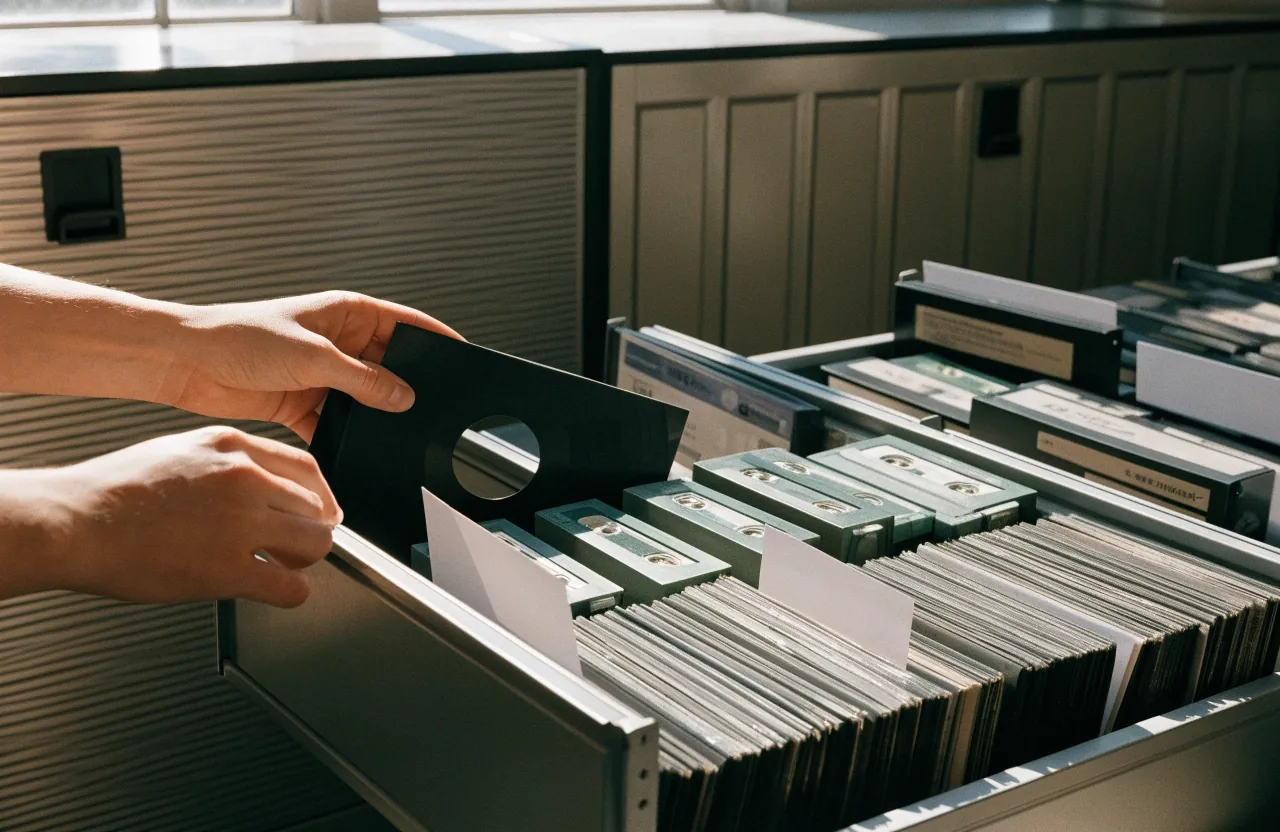
The daylight on the master file
The label's working idea is simple to picture. Daylight falls across an open master file, hands file the tape, and the catalog type crosses it like a weft. Every right, from master to publishing to royalty, stays in the same ruled file. The image stands for a practical habit, namely that no recording moves forward without its record moving with it.
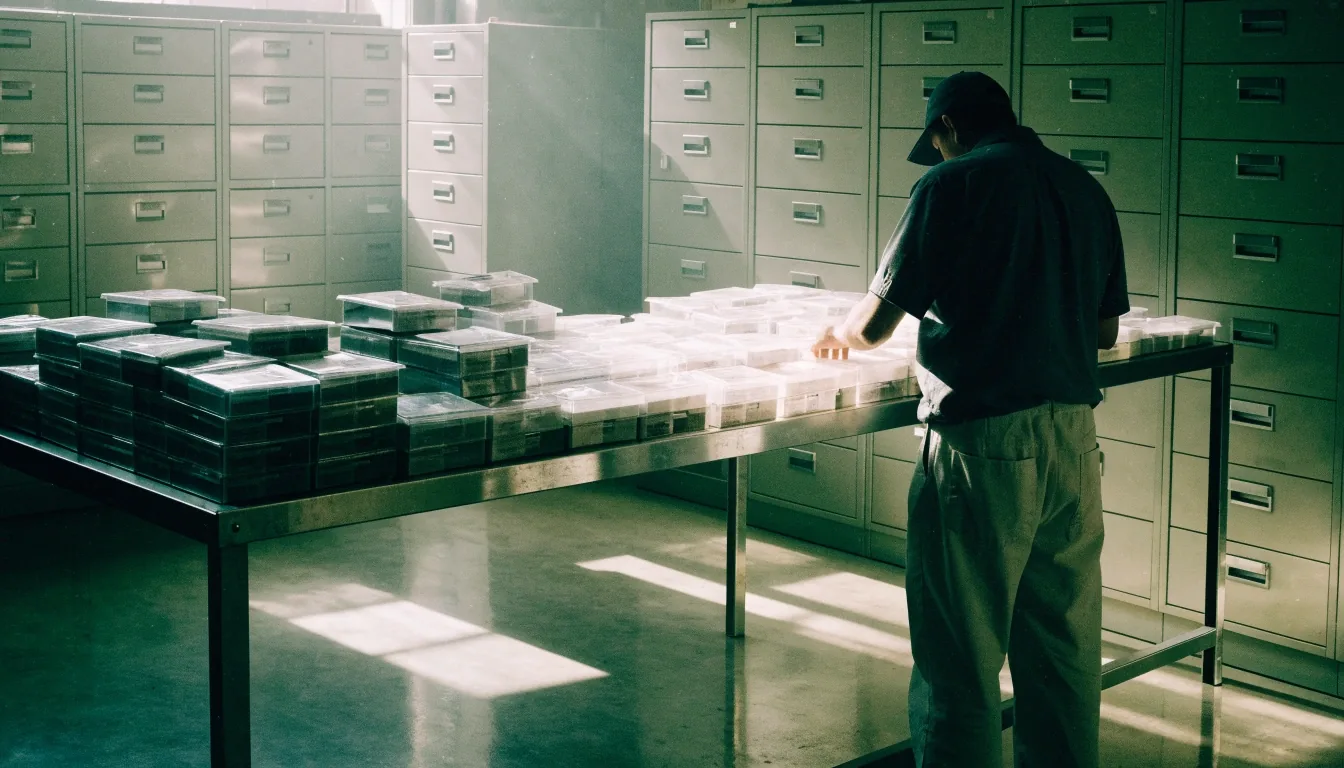
Visitors to the Sacramento office will recognize the room from this page: steel cabinets, a worktable, and the files themselves. The photograph is not decoration. It is a description of where the work happens and how it is checked — in daylight, by hand, against the record.
Learning from the wider industry
The U.S. industry includes major publishers, independent publishers, and rights infrastructure companies. Warner Chappell Music, Warner Music Group's publishing arm, administers a large songwriting catalog across performance, sync, and mechanical rights. Downtown Music Holdings, based in New York, represents the shift from pure publishing to end-to-end rights infrastructure. AUX File Recordings applies the same standards of documentation at independent scale.
Naming those companies here is not a claim of partnership. It is a standard to work to: know the writers, record the shares, track the uses, and report what the catalog earns. An independent label cannot administer a major catalog, and it does not pretend to. It can keep its own catalog to the same standard of clarity, and that is what visitors should judge it by.
What to expect
- Clear credits on every catalog title
- Written answers from the label itself
- Records that can be checked and corrected
Plain terms
What the label does not do
The label does not present itself as a government body, a bank, or a streaming platform. It does not claim awards, ratings, or artist endorsements that are not documented on this site. Visitors should judge the label by the clarity of its catalog, its written answers, and its records, which is how experienced users evaluate any label.
That boundary is deliberate. A label that sells music, distributes recordings, and administers publishing has a specific job, and doing it well means being precise about what it is. If a question falls outside that job, the honest answer is to say so in writing, not to stretch the label's description to cover it.

The rights file crosses the desk the same way it crosses the catalog — one record, checked line by line.
Who it serves
Who the label serves
The label serves artists with finished recordings, songwriters who need publishing administration, and rightsholders who want a catalog documented and reported. It also serves listeners and partners who want to buy or license music from a catalog with clear credits. Each group has a page on this site that states what information to send and what happens next.
Artists and songwriters
Bring a finished recording or a finished song. The label prepares the release, files the credits, and keeps the ownership record current, so you do not have to manage catalog paperwork alone.
Rightsholders, listeners, partners
Buy, license, or ask about a title from a catalog with clear credits. If you hold rights in work the label handles, a written enquiry starts with the title and the credit you are asking about.
Reach the label
How to reach AUX File Recordings
The email address is [email protected], and the Sacramento address is listed on the contact page with working hours. A written inquiry is the best first step, because it gives the label the title, credit, and purpose needed to check the catalog record. The contact page explains how to structure that message.
Include the title of the recording or song, the credit you are asking about, and what you would like to do — buy, license, submit a release, or ask about publishing. That is enough for the label to find the file and reply with the next step.